

Fablehaven: An Orientalist Fantasy
In which the author complains about yet another thing
Part 1: Kinderszenen
Okay, I really don’t know how many people this essay is going to resonate with. But I’ll start with something relatable: I loved the fantasy genre as a kid. I read all seven Harry Potter books and then I read all five Percy Jackson books, multiple times each. So imagine one day when my mom got me a brand new book series and told me, “It’s like a mix of Harry Potter and Percy Jackson!” I was going to be hooked instantly. My fate was sealed.
Brandon Mull’s Fablehaven concerns the adventures of Kendra and Seth Sorenson, two kids from ordinary suburban America pulled into a secret magical world. In this world, creatures of myth and fantasy–fairies, nymphs, trolls, and more–are real, hidden away from the mundane world on a set of secret preserves. Our protagonists explore a preserve owned by their grandparents named Fablehaven (the series’ namesake) and are drawn into a great battle between good and evil. Kendra and Seth race to discover powerful magical artifacts and keep them out of the wrong hands, as dark forces seek to open the demon prison Zzyzx[1] and unleash its denizens upon the world.
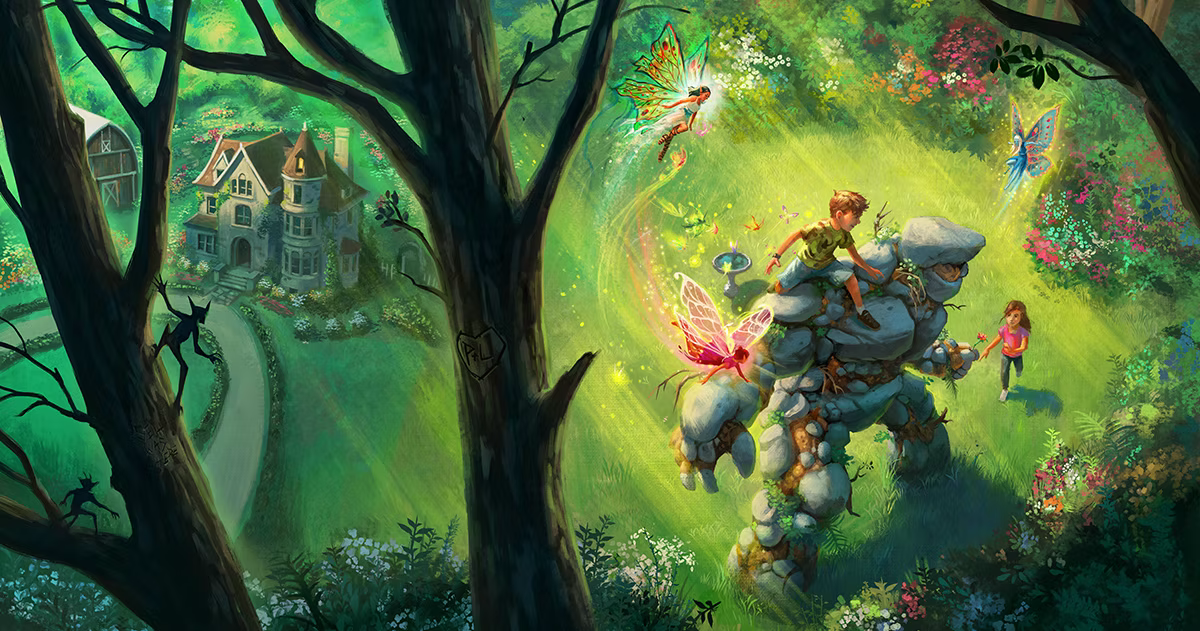
Image by Brandon Dorman
These books were my childhood–I even got mine signed by the author! But it took me much longer to realize that Fablehaven might be the most blatant example of Orientalist fiction I’ve ever directly consumed. There are no snake charmers, mystic fakirs, or scheming mandarins in this series, but do not be confused: this series directly reproduces the dynamics of Orientalism. It’s couched in just enough fantasy trappings to hide behind plausible deniability, but the Orientalism is there if one puts the pieces together.
Yet for all the popularity Fablehaven enjoys (that new movie adaptation must exist for a reason), I have never found anyone willing to pick it apart in this manner. So let’s be proper leftists and ruin some people’s childhoods[2] today. How does Fablehaven treat the world of magical creatures? What parallels are drawn between them and real-world cultures? And what does this series have to say about hierarchy, control, and rebellion among those perceived as the Other? We have much to get through; let’s not wait a moment longer.
Part 2: Prelude to the Afternoon of a Faun
Who are the creatures of Fablehaven? The magical creatures of this series (henceforth referred to as “fables”) are a diverse bunch. Many are taken from various world mythologies: Greek satyrs, Norse trolls, Arabian djinns, Jewish golems. Many bear similarities to other fantasy media such as The Chronicles of Narnia or Dungeons and Dragons. A few fables are wholly original to Fablehaven. Some are fully sapient and live in complex societies; others are little more than animals. Yet commonalities exist between them, and it is pertinent to analyze them as a whole. This world is its creatures, and the themes of the series are evident in the characterization of fables.
In most works of urban fantasy, magic is hidden from mundane life but not entirely separated. Magical worlds often allude to real-world history, with the implication that events in our world are secretly guided by supernatural forces. In Harry Potter, the British prime minister knows of the existence of wizards. In Percy Jackson, the Empire State Building is a secret portal to Mount Olympus[3]. Fablehaven is different in this regard. Fables play little to no role in recent history at all. In the ancient past, they served as inspirations for myths and folktales, but the progress of civilization has entirely sidelined them. Fables today remain fully cut off from the mundane human world[4]. Their last remnants remain on preserves, where they may exist safe from human influence but are confined to specific territories, unable to leave of their own volition.
On preserves, fables maintain their own way of life, largely removed from modern technology and society. The laws of fables are ancient and esoteric, based on “the law of the harvest, the law of retribution.” Crossing a forbidden boundary or using magic to harm a fable usually invites an immediate, eye-for-an-eye retaliation. Some fables hoard gold and treasure, but the concept of currency is foreign to fables: trade is conducted by bartering, by exchanging favors and services. Fable laws also follow the seasons: four times a year, during the winter and summer solstices and the spring and fall equinoxes (the so-called festival nights), fables are free to leave their domains and practice magic at will.
Festival nights have a dangerous reputation, as preserve laws protecting humans no longer apply during those times. But the world of fables is generally hostile to human beings. Naiads, beautiful spirits who live in lakes, entrance humans and drown them for amusement. Witches and demons imprisoned on preserves try to bargain with humans to escape and wreak havoc. Dragons possess so much raw magical power that they can paralyze humans by merely being in their presence[5]. Rarely, though, fables are close to benevolent. Satyrs are hedonistic partygoers who avoid conflict whenever possible; centaurs are proud, aloof warriors with little desire to interact with humans. Some of the first creatures introduced in the series are fairies, tame enough that a few wealthy individuals collect them as exotic pets[6].
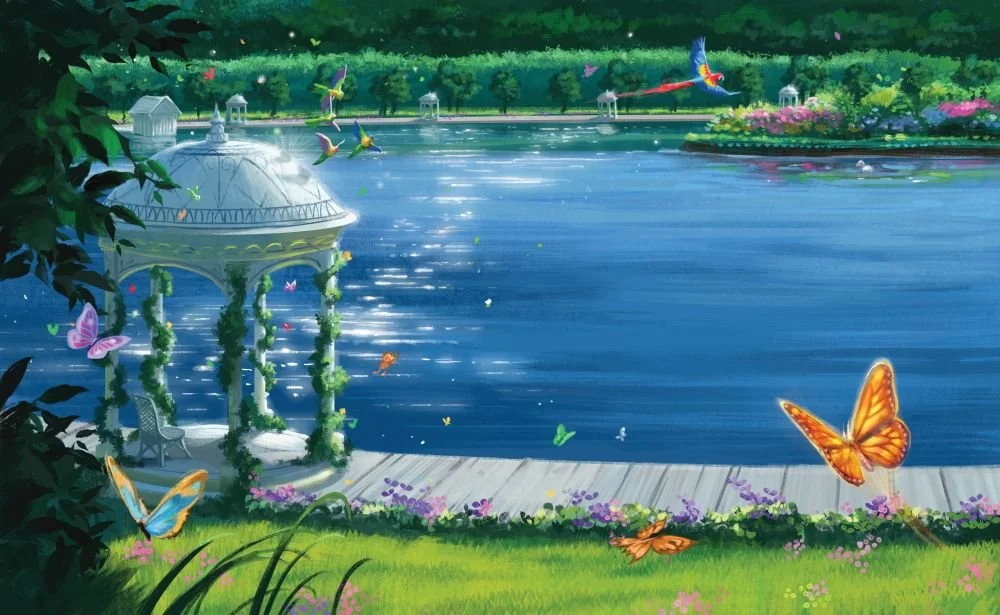
Image by Brandon Dorman
So the fables are exotic and separate from our own world. Their laws are ancient and primitive, predating “civilized” codes of conduct. They are dangerous and violent but alluring and submissive in equal measure. Gee, why does that sound familiar? In constructing the world of fables, Brandon Mull has effectively turned them into the Orient: a separate world of savage, mystical people driven by emotion and instinct, a glamorous foreign world that exists for our mundane heroes to adventure into. The human world stands in for the familiar West, and the magical world for the margins, the Other, the exotic East.
In fact, many details of the Fablehaven setting depict a colonizer-colonized relationship between humans and fables–perhaps its greatest distinction from series like Percy Jackson or Harry Potter. Once upon a time, fables existed around the world, until human expansion forced them from their homes. The preserves, where fables live today, are entirely governed by humans (though with a veneer of kindness–they are “caretakers,” not rulers). Many fables are unhappy with human control over their lives: an organization called the Society of the Evening Star considers preserves akin to prisons and is portrayed as a resistance movement. The metaphor is made most explicit, however, in that numerous fable characters are described as Asian or Asian-coded—a notable detail given almost none of the humans are! Some examples are listed below:
Lena, a naiad working for the Sorensons, whose “features suggested a hint of Asian ancestry”
Mr. Lich, a viviblix[7] who first appears as “a tall Asian man in a black suit”
Graulas, a demon, whose “…memories are of ancient India and China”
Mirav, an evil wizard who “came out of India,” and wears a turban and a braided beard
The Gray Assassin, a hooded ninja-like mercenary wielding two swords made of dragon teeth[8]
Several fairies collected by Maddox, a fairy trapper, comprising specimens from Indonesia, Timor, Malaysia, Borneo, and the Gobi Desert
The Living Mirage preserve in Turkey, home to creatures of Near Eastern mythology such as the roc and lamassu
But the world of Fablehaven is not merely Orientalist in its appearance. Orientalism is more than an aesthetic; it comprises a system and an ideology. If Fablehaven is truly Orientalist fiction, the proof will be found in its plot structure and themes. The next few chapters will take a look at more specific aspects of Fablehaven from the character archetypes it employs to the moral lessons it preaches.
Part 3: Madama Butterfly
No individual story arc in Fablehaven reeks of Orientalism as much as that of Patton and Lena Burgess. Patton Burgess is a legendary figure in Fablehaven, the self-appointed “world’s greatest adventurer.” In a setting notable for its danger to humans, Patton ventured deep into the fable world, accomplishing many daring, nigh-impossible feats. In his life, Patton tamed dragons, recovered rare and powerful artifacts, and discovered the fable world’s deepest secrets[9]. Though he is long dead by the time of the main series, he leaves his findings in a series of journals which the protagonists of Fablehaven frequently turn to for information and advice.
Patton appears most prominently in the third Fablehaven book, when Kendra travels with the Knights of the Dawn[10] to recover one of the keys to Zzyzx: the Chronometer, a time-traveling artifact[11]. When they find the vault containing the Chronometer, however, they are shocked to find it missing, for Patton stole it decades earlier and transported it to Fablehaven for safekeeping. Upon recovering the Chronometer, they use it to bring a younger Patton into the future, where he explains that he believed it was more safely hidden under his care: “The Knights of the Dawn mean well, but organizations like that have a way of keeping secrets alive and helping them spread. I knew only one person in the world I would trust with such vital information. Me.”
Of course, this should raise some immediate questions to the reader. Why does Patton’s sole judgement outweigh that of an entire institution dedicated to the protection of the artifacts? Why is his act of theft praised as heroism? Why didn’t he just go all the way and donate the Chronometer to the British Museum? The time-traveling device would fit right beside numerous stolen artifacts from China, India, and Egypt. (The Chronometer was hidden on a mesa filled with Indigenous-inspired fables, so it fits the bill in more ways than one!)
Not content rearranging the order of the fable world at will, the conqueror Patton must also win the ultimate prize from his travels: his wife Lena, a naiad turned human. The description of Lena as a prize is no accident: Patton sees Lena not as an actual human being but as a possession. Patton regards naiads as the most selfish fables at Fablehaven: “It is difficult to win the attention of a naiad. Their only preoccupation is their next diversion.” Lena’s appeal to Patton comes not from her personality so much as her difficulty to get a hold of–and thus the greatest personal reward when she is finally won over. He thus employs every tactic he knows to seduce her over a period of three whole years until she finally gives in, refusing to take no for an answer. “It was clear that he obsessed over her,” Kendra observes reading his journal entries. “He knew what he wanted and never relented until she was his.”
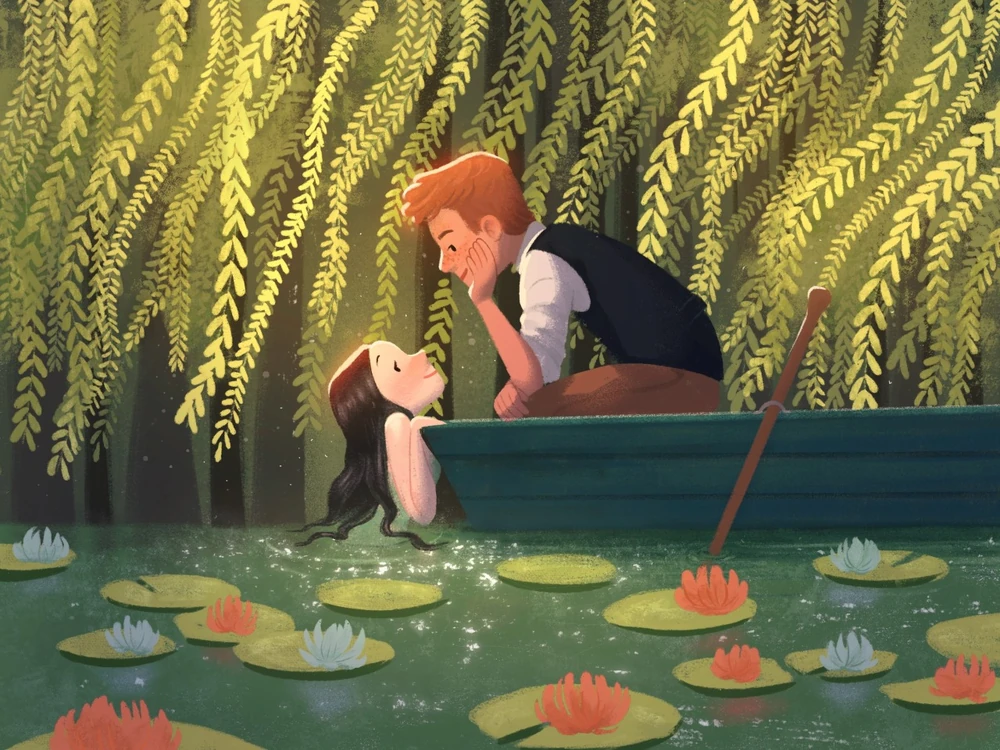
Image by axelorie
While many Asian-coded characters in Fablehaven are male and villainous, Lena exemplifies a stereotypical Asian femininity, docile and helpful to humans. Particular attention is given to her Asian appearance: Kendra initially mistakes her for “the half-Chinese housekeeper,” and Lena admits that Patton was particularly attracted to her eyes: “He said he was of the Asian persuasion.” Lena proves useful to the Sorensons as a domestic servant; her skills include cooking, housekeeping, and giving massages (of course)[12]. She plays a similarly passive role in the plot, expositing information to Kendra and Seth, being captured by the villains, or being wooed out of the water a second time[13] by a time-traveling Patton.
Lena also features heavily in the climax of the third book, exemplifying a particularly persistent myth: the distinction between the “good colonizer” and the “bad colonizer.” When a privileged class in society–billionaires, men, the police–is confronted with its own abuses of power, it often blames them on individuals, the few “bad apples,” rather than the system itself. This manifests in Fablehaven through the contrast between Patton and his uncle, Marshal Burgess. Marshal, like Patton, fell in love with and married a fable woman, a dryad[14] named Ephira. Unlike Patton, Marshal was ultimately unfaithful, driving Ephira to darkness. In the present day, she threatens to destroy Fablehaven in revenge.
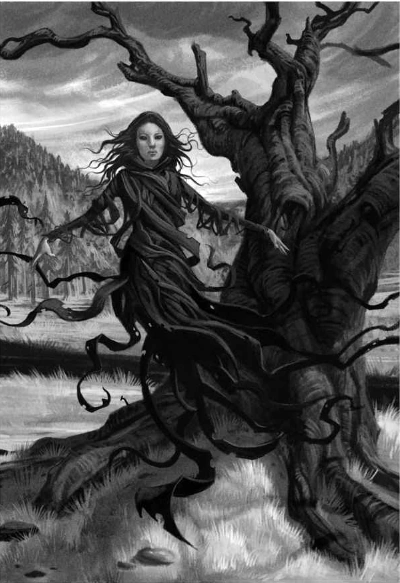
Image by Brandon Dorman
The protagonists eventually find a method to kill Ephira, at the cost of also killing the person who performs it. Patton contemplates sacrificing himself, but it is ultimately Lena–in the grand tradition of Madama Butterfly’s Butterfly and Miss Saigon’s Kim–who gives her own life to save the preserve and allow Patton to return to his timeline. Her one act of agency in the whole series is sacrificing herself to save Patton’s future[15]. slow clap The good colonizer defeats the bad one, I guess. Way to go.
In his grief, Patton resolves to return to the past version of Lena and fully devote himself to her. He resolves to be the good colonizer that, yes, steals his wife from her home and her immortal life, but loves her in the right way. But this “love” takes on an unsettling turn given Lena’s eventual destiny. Is Patton not effectively grooming his wife to die for an alternate version of him? Lena in the present speaks fondly of her relationship with Patton, but Patton’s love is profoundly one-sided: everything he does for her is ultimately to convince her to one day sacrifice her life for him–a sacrifice he has no intention of making himself.
Ultimately, the similarities between the Patton the good colonizer and Marshall the bad colonizer outweigh any minor aesthetic differences between them. Both take fable women from their homes as a show of power, consider them less than human, and take actions that directly or indirectly cause their death. Lena’s fate is made out to be a tragedy, but it was never inevitable. Her death was caused, indisputably, by the actions of Patton Burgess–but Fablehaven is uninterested in criticizing him. He is lauded as the ultimate white savior (human savior?), flawless and untouchable. Patton’s role in killing Lena is merely framed as a source of character development for him. Even in death, she is denied treatment as a full human being. I only have three words to say in conclusion: Lena deserved better.
Part 4: En blanc et noir
It is stated throughout the series that the minds of fables are alien to us; so alien, in fact, that basic human ideas of good and evil do not apply to them. Grandpa Sorenson, caretaker of Fablehaven, warns that: “None of these creatures are good. Not the way we think of good. None are safe. Much of morality is peculiar to mortality. The best creatures here are merely not evil.” Fables follow their own moral axis between light and dark[16]–in practice, usually equivalent to good and evil. Yet light and dark have unique traits, and these are essential to understanding Fablehaven’s message.
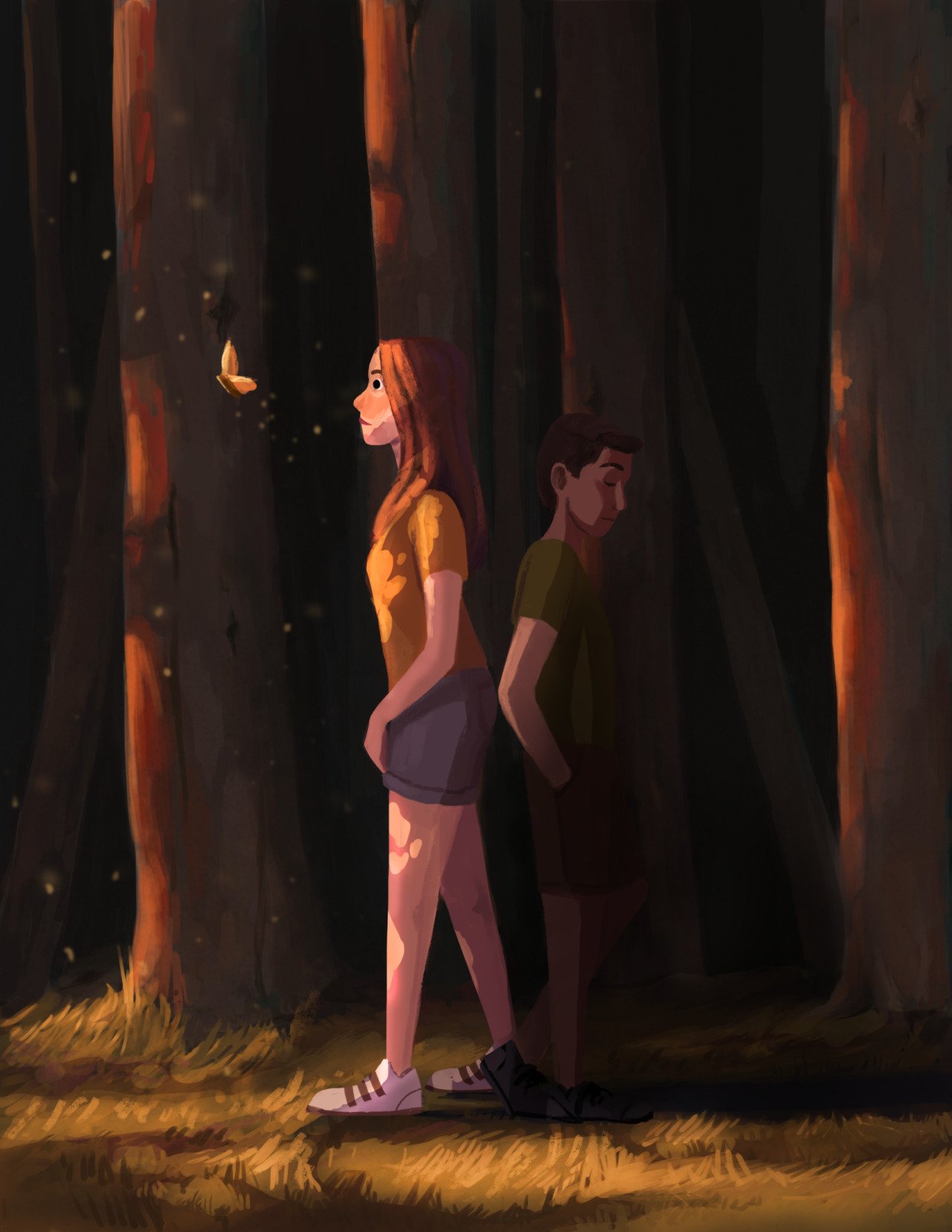
Image by axelorie
What exactly are light and dark in Fablehaven, as opposed to good and evil? The answer is that good and evil are a matter of choice, whereas light and dark are not. Grandpa Sorenson explains that fable morality is much less nuanced than human morality: “For the most part, unapologetically, magical creatures are what they are. They tend to be less self-aware than humans…compared to magical creatures, we humans are much more able to suppress our natural inclinations in order to deliberately choose our identities.” Fables are defined by essentialism, with light and dark being innate, fundamental qualities[17]. They are explicitly less than human: less aware, less complicated, less developed.
The unchanging nature of dark fables also conveniently justifies the extensive use of prisons by the forces of light. An entire race of dark beings, the demons, has been incarcerated in the demon prison Zzyzx for thousands of years. The Society of the Evening Star seeks to open Zzyzx specifically because it considers the incarceration of demons unjust. Yet the prison is deemed necessary, as the alternative is unbridled chaos and destruction if they were ever to be set free. “The most violent and malevolent demons are imprisoned, yes,” says Grandma Sorenson, “but that is for the safety of the world. In pursuit of endless carnage and unlawful dominion, they clashed anciently with good humans and creatures of light, and are paying a heavy price for losing.”
The unicorn Bracken gives perhaps the most coherent argument for imprisoning the demons: “I’ve spent time in prison. It’s inhumane. But prisons serve a necessary purpose. Prisons protect the freedom of the masses from those who abuse their freedom.” The real-life prison abolitionist movement seeks to replace a carceral justice system with a transformative justice system–where interpersonal harms are placed within a larger social context and dealt with by the community, rather than a detached and impersonal state apparatus. Prisons serve to control minorities and maintain the power of the state instead of actually reducing harm. But in Fablehaven, there is no larger social context to speak of. Dark fables hurt and destroy because it is their nature. Thus, dealing with beings of darkness requires their eternal imprisonment–apparently the more reasonable alternative to another option, the outright genocide of dark creatures![18]
Fablehaven also associates light and dark with various other qualities. If light and dark essentially signify good and evil, they also signify order and chaos: dark fables prefer “chaos and bloodshed” to the “just regulations” of humans and light fables. Fablehaven thus reifies an age-old dogma, that hierarchy is order. Prisons are not only good and just but essential to keep society functioning. Of course, similar arguments exist in our world: capitalism, racism, patriarchy, and other hierarchical systems have defended themselves in this manner time and time again. They claim to be the only thing preventing society from complete and utter collapse, erasing even the possibility of alternatives[19].
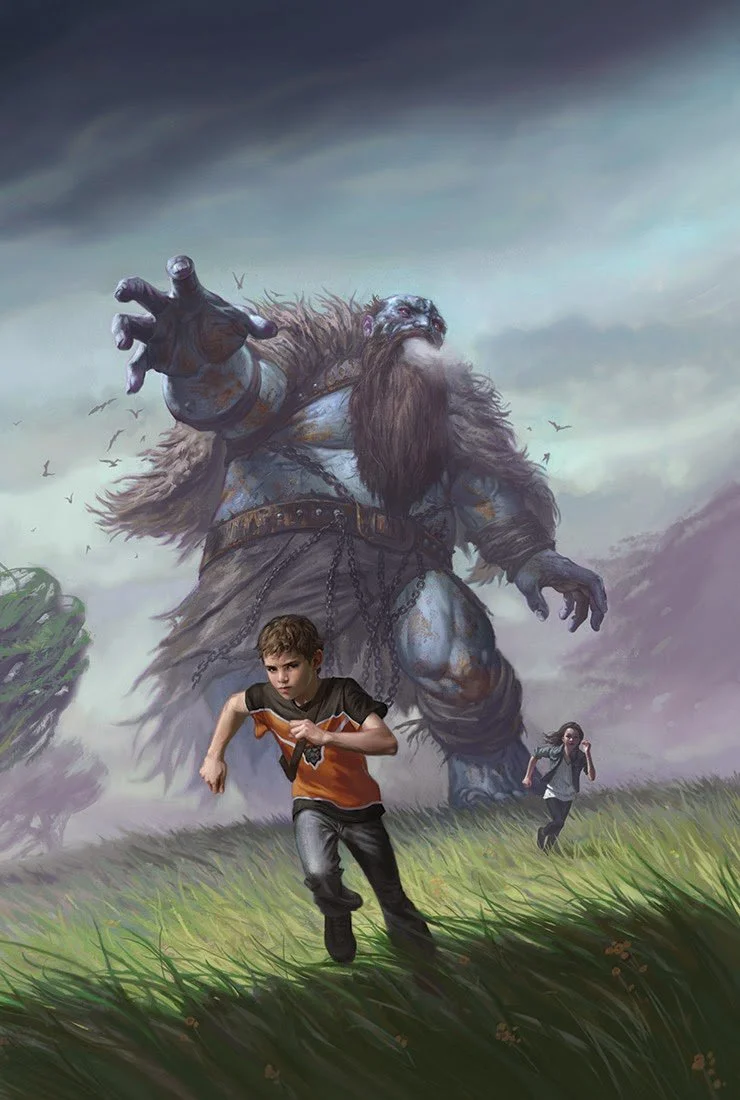
Image by Eric Deschamps
In addition to order and chaos, light and dark are also conflated with creation and destruction. At the climax of the fifth book, the demons of Zzyzx are tempted into invading the realm of the fairies. They enter to find the realm closed off, and its last portal to the human world turned into a new prison gate. The fairies promptly move into Zzyzx itself, converting it into the new fairy realm. The Fairy Queen takes the opportunity to expound on the difference between light and dark fables: “Before long, the demons will render my former realm as ugly as Zzyzx. But they will never re-create what they have spoiled. Conversely, with time and effort, one day Zzyzx will become as lovely as my former realm.”
These conflations between good and evil, order and chaos, creation and destruction, are common tropes in media. They ignore, however, that evil loves to create–it creates things like prisons, police, and systems of slavery. If destruction itself is evil, how are we to get rid of evils that already exist? Perhaps a better characterization of evil is neither creation nor destruction but preservation, maintaining a system at all costs no matter how harmful it is. In this light, one could consider the fairies of Fablehaven, in their continued imprisonment of the demons, preservers rather than creators. One may then recall the words of Mikhail Bakunin: “The passion for destruction is a creative passion, too!”
Part 5: New World Symphony
Fables are enormously powerful, wielding immense magic and being nigh-immortal. Yet humans dominate the modern world, and fables are confined to tiny pockets of it. Even fables of light are not much freer than their dark counterparts in Zzyzx. So the question arises: how did humans ever manage to force them into preserves in the first place? This question is answered at two separate points. In the first book, Lena details the fall of fables’ relationship with humans:
“Many of the beings who dwell here existed gracefully when primitive man foraged in ragged tribes. We taught man the secrets of bread and clay and fire. But man became blind to us over time. Interaction with mortals became rare. And then mankind began to crowd us. Explosions in population and technology stole many of our ancient homes. Mankind had no particular malice towards us. We had simply faded into colorful caricatures inhabiting myths and fables.”
Lena paints a picture of an idyllic “before-time” where fables and humans lived as equals. But as humans developed, fables remained static. They failed to keep up with technological advancement and faded to the margins of the world. Lena’s answer seems sufficient for the purposes of the main series, which elaborates no further on the subject. However, the issue of how fables were confined to preserves remains open.
Another clue comes not in Fablehaven proper, but the sequel series, Dragonwatch[20]. In the first Dragonwatch book, Kendra travels with Bracken to meet Jubaya, a demon asking to negotiate with her. Kendra questions whether Jubaya’s intentions are genuine, but Bracken reassures her that “…demons tend to keep their formal vows. All magical creatures do. Our natures allow certain oaths and promises to bind us. It is partly how preserves like Fablehaven were founded and how rules were established.”
This almost throwaway statement reveals a great deal about the fable world. Fables have tremendous power, but they have one major weakness: dark or light, they are bound by contracts. Their adherence to contracts thereby dictates the social conditions they live in. If fables agreed to confine themselves to preserves in the distant past, they are now stuck there in perpetuity. They are helpless to change their own social arrangements, no matter how unfair they find them.
Contracts exert incredible power over fables throughout the Fablehaven series. The laws of a preserve, for instance, prohibit fables from harming a human being except in retaliation. In the first book, Kendra finds herself surrounded by imps, who have captured her family members and allies. Yet she is shocked to find that “…the imps were not taking hold of her. They stood all around her, yet they seemed unable to reach out their hands and grab her. They would lift their arms part of the way and then stop, as if their limbs refused to obey.” To humans, preserve laws are little more than words on paper. To fables, they are an absolute physical obligation.
Why all this fuss about contracts? Simple: the portrayal of fable society as permanent and unchanging evokes long-established rhetoric about Indigenous people. Much discussion around Indigenous characters in fiction revolves around the “noble savage” trope: the idealized native who shuns modern civilization, living in harmony with nature and imparting mystic wisdom onto the colonizer. Debates abound on whether the noble savage is a pro- or anti-Indigenous stereotype, but it remains a key part of our political discourse.
The significance of the noble savage, however, was challenged by David Graeber and Dave Wengrow in their book The Dawn of Everything. The more damaging myth, they argued, was not the noble savage but the “stupid savage,” who lived in an unchanging and simple society, incapable of higher political thought. During the colonization of the Americas, Indigenous tribesmen such as the Wendats observed European society for the first time and were shocked at the levels of social inequality there. The myth of the stupid savage was created as a response; yes, Western society was deeply stratified and hierarchical, but that was inevitable. True equality was a distant memory, a possibility long removed by the inventions of agriculture, cities, and states. And if Indigenous societies were more egalitarian than theirs, it was only because they were stuck in a primitive state, politically underdeveloped and backwards[21].
The social world of the Other, as told by the colonizers, is a mind-numbingly simple one, where no significant change ever happens. It is curious, then, that Lena describes life as a naiad in similar terms: “I lived in an unchanging state for millennia, never thinking of the future or the past, always looking for amusement, always finding it. Almost no self-awareness…. A single moment that lasted thousands of years.” She chooses mortality to escape that unchanging boredom. Fablehaven has written its fables as the stupid savages, with all the political implications that follow.
In Fablehaven, human beings alone possess social consciousness, the ability to reshape their world and their institutions. Fables are rendered entirely dependent on humans to create social systems for them. Thus human domination over preserves is justified: how could fables even think of governing themselves? The world that humans create is obviously the superior one–never mind the artifact thefts and the prison system. The Other cannot create; it cannot imagine. Only humans (Fablehaven’s stand-in for the West, remember) can do that. Fables are not merely different from us: they are lesser, they are simpler, they deserve to be ruled.
Part 6: Revolutionary Étude
But wait a minute! If fables cannot remake their own social conditions, how does the Society of the Evening Star even exist? How can fables rebel against human domination? This is given a simple solution: that desire, too, is bestowed upon them by humans. Enter the Sphinx, the main antagonist of the series and founder of the Society. He uses magic–he has prolonged his life for centuries with the Font of Immortality, a key to Zzyzx–but he was born human and enjoys a freedom from the contracts that bind fables. He is followed by his legion of revolutionaries–Mr. Lich, Mirav, the Gray Assassin, and many other fables of the fantasy Orient.
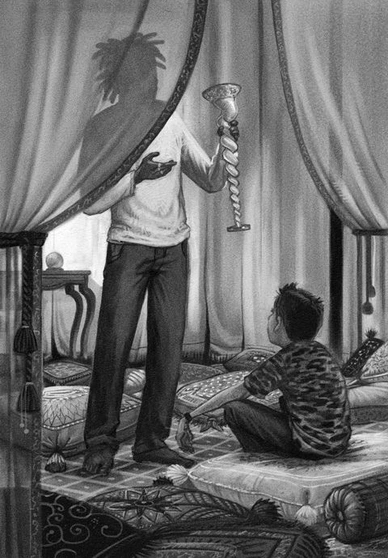
Image by Brandon Dorman
The Sphinx is also notable as the only character of Black African descent in the Fablehaven series[22]. And why did he create the Society? Centuries ago, the Sphinx was held as a slave on the Living Mirage preserve. To free himself, he bargained with an imprisoned demon to gain power, overthrowing his masters and taking control of the preserve. He then set out to overthrow all preserves and release the demons from Zzyzx, viewing them as equivalent to his own enslavement. He explains his motivations to Seth in the fifth book:
“With or without me, eventually that prison will be opened. Where others would fail and unleash ruin upon the world, I will succeed. In time, I will use the power of my position to reinstate balance in the world so that magical creatures won’t have to cower in preserves and prisons. By virtue of my position, I will use evil to bring about good.”
“I have prepared. I am certain. I have been a slave, Seth. As master, I will release the prisoners and create a world without slaves.”
That’s right! The stated goal of Fablehaven’s main villain, the reason why he has killed and deceived and manipulated for centuries, the reason why he has allied himself with all the evilest beings in this world, is…abolishing slavery. And prisons (which really aren’t that different from slavery to begin with). He’s yet another “has-a-good-point-but-inexplicably-uses-absurdly-extreme-methods-and-thus-can’t-possibly-be-right” villain. I’m genuinely shocked that #TheSphinxWasRight never got trending on Twitter during the run of the series.
Of course, the Sphinx can’t just be right, as that would prove fables actually deserve their freedom, an incomprehensible thing in Fablehaven. So he is written to fail from the start. He is made out to be a hypocrite, in that he claims to be against prisons while running a prison of his own. He is unable to control the demons, who double-cross him and divert the Society to their original goal of uncontrolled chaos. And the moment his plan goes off the rails, he immediately betrays his own revolution for the Knights of the Dawn, deciding he prefers their version of order, however oppressive it may be, over demonic chaos. Upon the defeat of the demons, he is granted a supposedly merciful sentence–his life force is tied to the new demon prison, letting him keep his immortality in servitude to the system he fought so hard to overthrow.
A similar thing happens with the main villains of Dragonwatch, the titular dragons. Dragons are unique among fables: in addition to their great intelligence and power, they are considered “more humanlike” than other fables, in that they are not innately tied to light or dark. Fittingly, they also express the most agency of any fable race. Many object to life on their sanctuaries and desire independence from mortal rule. Celebrant, the king of the dragons, kicks off the plot of Dragonwatch by gathering the dragons together in rebellion against the preserve system[23]. When he is defeated at the end of that series, the remaining dragons are unceremoniously routed and sent back to their sanctuaries, their revolution scattered and broken up without a leader.
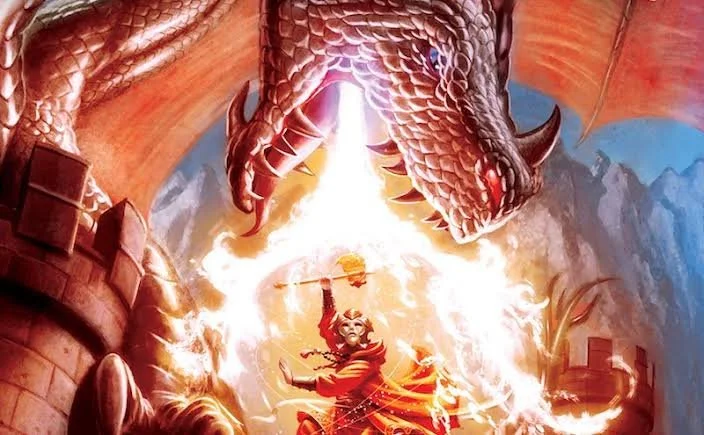
Image by Brandon Dorman
In both cases, Fablehaven tells the following narrative about revolution: a lone figure dreams of freedom for lesser beings, single-handedly imparts that desire upon them, and then rebels against the forces of light, who must subdue them to preserve order (or really, preserve hierarchy). The figurehead is killed or severed from his organization, which promptly disables the entire revolution. The rest of his forces, with no agency of their own, turn right back to their place at the bottom of the pyramid. Their failure proves that society is structured in the correct way, and that changing it can only end in complete disaster.
So, humans alone can imagine different social environments. But the lesson of both Fablehaven and Dragonwatch is that using that ability to make a better world for fables is wrong and should be punished. Isn’t that such a bleak, cynical, waste of imagination? One of Fablehaven’s fundamental principles of magic is: “Everything that has a beginning must have an end.” This principle evidently doesn’t apply to the colonization and imprisonment of fables. That can never end. Fablehaven’s main characters uphold that system and are lauded as heroes. What a moral to teach children: The Others are scary! They’re dangerous! Give them freedom and they’ll destroy everything! But keep them in line and society will keep working, just as normal! Don’t question it! Ever!
Part 7: The Unanswered Question
Why critique children’s fantasy novels? I’m sure somebody’s asking that now. Why write about this and not something that actually matters? The answer is that this series does matter. It is far more than just a children’s book. Fablehaven reached the New York Times bestsellers list multiple times and garnered praise from prominent fantasy authors. Plenty of people, including myself, read this series at a formative age. Numerous anecdotes have people citing Fablehaven as the series that got them into reading. It launched Brandon Mull’s writing career and spawned multiple spin-off series. Not to mention the film adaptation, currently in production as of this writing, which is bound to introduce this work to a whole new audience[24]. Fablehaven’s ideology is immensely relevant: it tangibly influences how people see the world.
I begin this essay by referring to Fablehaven as an Orientalist fantasy, but it is not merely Orientalist. It espouses, alongside Orientalism, anti-Indigenousness and anti-Blackness. I discuss these as well because they are cut from the same cloth as Orientalism–they are tools of the white supremacist colonial state. Orientalism is but part of a larger pattern, the intersecting systems of power and hierarchy. We can now see Fablehaven more fully for what it is: a reactionary work that fears revolution, justifies the status quo, and upholds structures of domination.
For the sake of perspective, Fablehaven is not the only YA urban fantasy series to have made excuses for hierarchy or domination. Harry Potter has been critiqued numerous times on this front: the house-elves being willing slaves, the love potions which function as date-rape drugs, the ending where the supposedly anti-authority protagonist becomes a cop for the magical government. Even Percy Jackson has faced criticism for its glamorization of “the West,” which the Greek gods supposedly embody–a retroactive lineage that is, once again, steeped in colonialism.
What is odd is that Fablehaven does not seem to have garnered anywhere near the same kind of critical attention as these two. Perhaps this is an issue of exposure. Both Harry Potter and Percy Jackson have enormous fanbases, high-profile film and TV adaptations, and a wider reach overall: Fablehaven has simply managed to slip under the radar. I say this is a shame–we can gain so much by analyzing it under the same lens. The antagonists of the series are a rebellion formed of Asian, Indigenous and Black people (and allegories thereof)? Where on earth are all the woke culture warriors? We’re missing out on so much here!
But it ultimately makes perfect sense that Mull has intertwined the tropes of mythology with the tropes of Orientalism, because Orientalism is mythology. Orientalism is a set of stories we tell ourselves to justify how the world works. The trouble is that what Orientalist mythology justifies is the colonization of Asia[25]. And the actual people of Asia would rather not be colonized in the first place. They would rather tell their own stories than hear yet another story telling them they deserve to have their lands invaded, their women fetishized, or their artifacts stolen.
I therefore close with a question for future writers. What if we treated foreign cultures as something we could learn from and share experiences with, rather than an exotic Other? What if we saw inequalities of power as changeable, rather than inevitable? What if we understood revolution not as the work of a single leader, but as the collective will of oppressed communities? What if the fictional worlds we wrote were filled with not just myth and magic, but different ways of organizing society? The Fablehaven books are advertised as a world of imagination. Let’s do what Brandon Mull can’t and take that imagination to its logical conclusion. What is stopping us from writing fantasy that subverts stereotypes, fantasy that challenges hierarchy–fantasy that liberates?
Endnotes
[1] Yes, that is named in reference to the town in California.
[2] Including first and foremost my own! Rest assured you will not be as hurt as I have been.
[3] I make no apology for repeatedly citing these two series as points of comparison; they are both well-known and similar to Fablehaven enough to be useful references.
[4] There are some rare exceptions–Zzyzx, for example, is located on an island in the Bermuda Triangle, which explains why so many ships have been lost there–but direct fable interaction with human history, even covertly, is next to nonexistent.
[5] Dragons are indeed so powerful that most reside on a special set of preserves, the Seven Sanctuaries, with even stronger protections than normal preserves. These are more extensively detailed in the sequel series Dragonwatch.
[6] If you’re wondering how fables stay a secret if human billionaires are collecting them, the true forms of fables cannot normally be perceived by the human eye: fairies are seen as butterflies, satyrs as goats, and golems as big piles of rock. Drinking a special enchanted milk gives people the ability to see them. To most of humankind, a collection of fairies would simply look like a rare butterfly collection.
[7] An invented fable of Mull’s, a sort of vampire that can reanimate the dead.
[8] The depiction of the swords is a little inconsistent: the text describes them as “slightly curved,” but illustrator Brandon Dorman draws them as straight-edged European broadswords. I am inclined to consider this an oversight and treat them more as katanas, complementing the ninja allusion.
[9] Patton’s feats include but are not limited to: learning the secret fairy language, obtaining an extremely rare unicorn horn, slaying a dragon, successfully entering a dragon sanctuary barred to human visitors, finding the hidden island where Zzyzx is located, and learning of the existence of the legendary sword Vasilis. This last one he claims he could have obtained but declined to, having “no pressing need for the weapon.”
[10] An organization within the series devoted to protecting preserves, serving the forces of light, and opposing the Society of the Evening Star.
[11] The other four keys to Zzyzx are the Sands of Sanctity, which can heal any illness or injury; the Oculus, which grants the user clairvoyance; the Translocator, which allows the user to teleport; and the Font of Immortality, which halts the aging of any mortal being who drinks from it.
[12] Lena is never explicitly depicted doing so, but she is stated to have taught Grandma Sorenson.
[13] At the end of the first book, the fairies take Lena and forcibly transform her back into her naiad form, whereupon she lives in the naiads’ pond and regresses back to her youthful self. She remains this way until Patton travels to the future and seduces her to come out once again.
[14] Technically a hamadryad, a distinction pedantic enough that I’m reserving it for a footnote–but one curious observation is that hamadryads are perceived as more flirtatious than regular dryads.
[15] Or is it Patton’s past? The time travel element makes this a little confusing to talk about.
[16] In general, fairies and “fairy-type” fables (satyrs, centaurs, unicorns) are light; demons, giants, and the undead are dark; and dragons lie across the spectrum.
[17] Though not entirely permanent: there are occasions where a fable’s alignment can be changed, such as creatures of light falling into darkness, which more or less completely rewrites their personality.
[18] I am not exaggerating. In the third book, Grandpa Sorenson debates whether dark fables have enough agency to actually be held responsible for their actions, stating that some “would use it as an excuse to eradicate all dark creatures, a notion I find detestable.”
[19] I refer here to the concept of “Capitalist Realism” first developed by Mark Fisher.
[20] Named for an in-universe organization dedicated to monitoring dragons. Reaching the height of its power during the formation of the Seven Sanctuaries, Dragonwatch has shrunk in size over many years, until it is revived at the start of the sequel series. At one point in history the organization consisted of a single member–Patton Burgess. (Obviously.)
[21] Which is, as Graeber and Wengrow stress, completely untrue–Indigenous American societies underwent many radical transformations long before Europeans set foot there, and many individuals were intelligent, well-spoken statesmen due to participating in the democratic councils that were part of everyday life.
[22] Despite his title, he is not actually Egyptian; he claims to come from what is now Ethiopia.
[23] Noted to be an unnatural occurrence, as dragons are normally solitary creatures–it is stated repeatedly in Dragonwatch that dragons are not meant to organize in collectives of any kind.
[24] I leave it to others to actually watch the upcoming film–produced by the conservative Christian media company Angel Studios–and apply the concepts in this essay to the adaptation.
As a point of interest, Brandon Mull himself is Mormon (like a surprising number of fantasy authors). Some may read into this as an explanation for Fablehaven’s ideas. But, like Uncle Roger’s accent, I do not find Mull’s religious beliefs that relevant, so my essay does not mention them. This series is not conservative because its author is Mormon; it is conservative because it makes excuses for prisons and colonialism.
[25] Analogous statements could be made about the myth of the stupid savage and the conflation of hierarchy with order.